


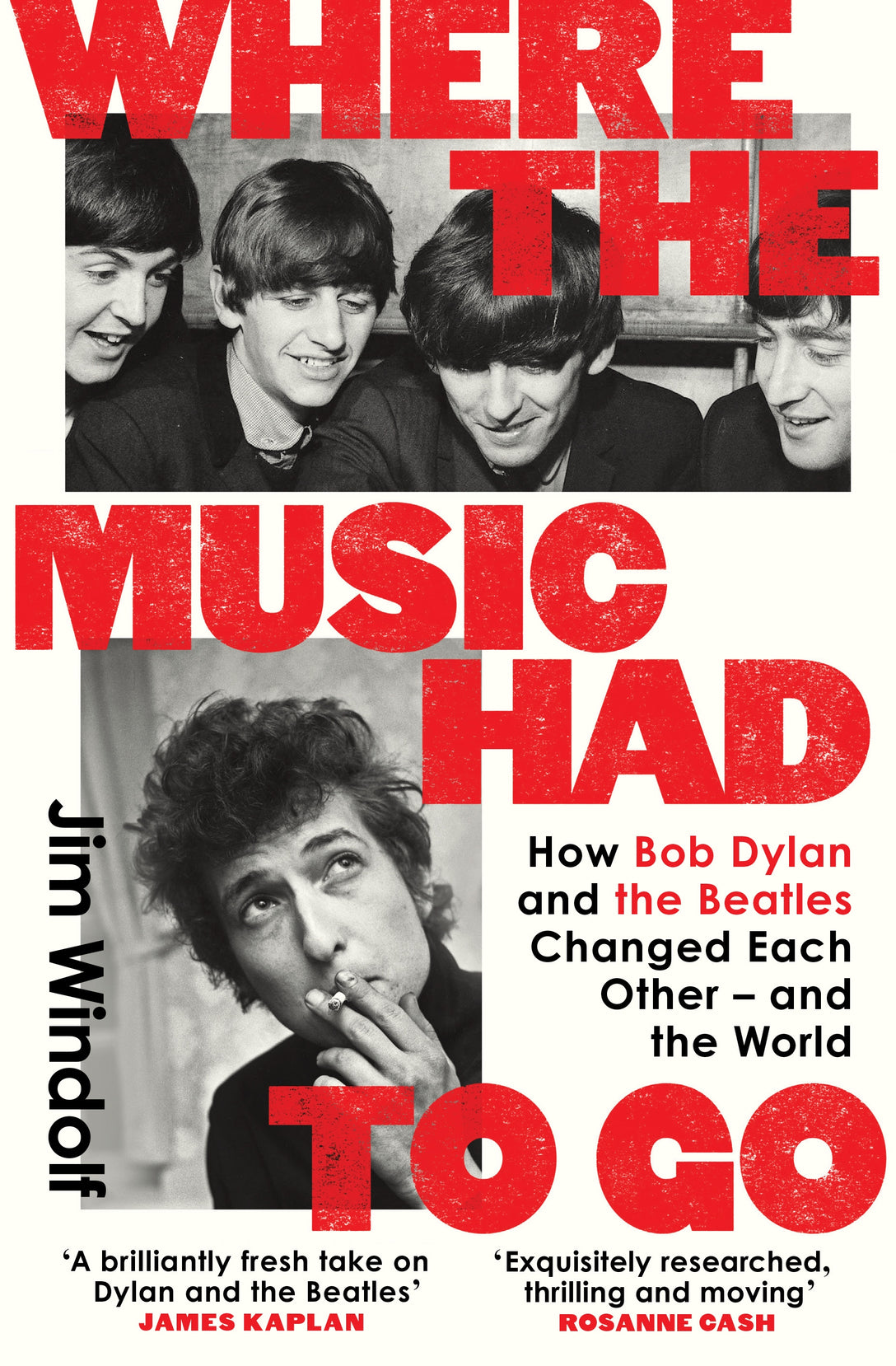
Where the Music Had to Go
How Bob Dylan and The Beatles Changed Each Other – and the World
- Author
Regular price
£25.00
Regular price
Sale price
£25.00
Unit price
per

- ✔️ Free UK delivery over £30
- ✔️ Careful packaging
- ✔️ Direct from the Publisher
Not available for shipping to the following countries:
- ASM
- CAN
- GUM
- MNP
- UMI
- FSM
- MHL
- PHL
- PRI
- USA
- VIR
FEATURING AN EXCLUSIVE NEW INTERVIEW WITH SIR PAUL McCARTNEY
'An astonishing amount of research' NEW YORK TIMES
'An easy and addictive read' MOJO
????? THE TELEGRAPH
'Meticulously [and] lovingly told in this delightful history' JANN WENNER
Persuasive, captivating and bursting with insight, this dual biography by acclaimed journalist Jim Windolf dives into the surprisingly supportive, occasionally rivalrous, always fertile relationship between Bob Dylan and the Beatles.
Few artists have shaped pop culture as profoundly as the Beatles and Bob Dylan. In Where the Music Had to Go, Jim Windolf offers a new, persuasive interpretation of how two of the twentieth century's greatest recording artists influenced one another - and reveals how their apprenticeships, accomplishments and legacies are uncannily intertwined.
From Dylan's early dismissal of the Beatles as being for 'teenyboppers' to his rapid acknowledgment of their talent, the book captures the pivotal moments that pushed Dylan to 'go electric' and inspired the Beatles to deepen their lyrics. Packed with vivid anecdotes (the Beatles rehearsing Dylan songs; Dylan spending hours at Lennon's childhood home), the book paints a picture of a relationship full of camaraderie, rivalry and mutual evolution.
Windolf's meticulous research uncovers hidden gems, peeling back layers of history to reveal the stories fans didn't even know they were missing. From Lennon's and McCartney's lyrical transformations to George Harrison's growth as a songwriter, the book showcases the ripple effects of the Beatles-Dylan connection. More than a music biography, this is a front-row seat to the forces that shaped the sound of a generation.
'An astonishing amount of research' NEW YORK TIMES
'An easy and addictive read' MOJO
????? THE TELEGRAPH
'Meticulously [and] lovingly told in this delightful history' JANN WENNER
Persuasive, captivating and bursting with insight, this dual biography by acclaimed journalist Jim Windolf dives into the surprisingly supportive, occasionally rivalrous, always fertile relationship between Bob Dylan and the Beatles.
Few artists have shaped pop culture as profoundly as the Beatles and Bob Dylan. In Where the Music Had to Go, Jim Windolf offers a new, persuasive interpretation of how two of the twentieth century's greatest recording artists influenced one another - and reveals how their apprenticeships, accomplishments and legacies are uncannily intertwined.
From Dylan's early dismissal of the Beatles as being for 'teenyboppers' to his rapid acknowledgment of their talent, the book captures the pivotal moments that pushed Dylan to 'go electric' and inspired the Beatles to deepen their lyrics. Packed with vivid anecdotes (the Beatles rehearsing Dylan songs; Dylan spending hours at Lennon's childhood home), the book paints a picture of a relationship full of camaraderie, rivalry and mutual evolution.
Windolf's meticulous research uncovers hidden gems, peeling back layers of history to reveal the stories fans didn't even know they were missing. From Lennon's and McCartney's lyrical transformations to George Harrison's growth as a songwriter, the book showcases the ripple effects of the Beatles-Dylan connection. More than a music biography, this is a front-row seat to the forces that shaped the sound of a generation.
- Published: Apr 16 2026
- Pages: 400
- 238 x 152mm
- ISBN: 9781399627849
Press Reviews
- JANN WENNER, co-founder of Rolling Stone
The friendship between Bob Dylan and the Beatles and how they influenced, competed with, and revered each other is meticulously, lovingly told in this delightful history of a magical world in an historic era
- TOBY THOMPSON, author of Positively Main Street: Bob Dylan's Minnesota
Dylan's and the Beatles' relations were more than comradely or competitive. They became a call and response - a tit for tat - that was an exploration of the consciousness of their generation. Jim WIndolf explored this dynamic brilliantly in Where the Music Had to Go. It's a book for serious fans and students of the '60s and '70s that's not to be missed
- LEE CHILD, bestselling author of the Jack Reacher novels
One-part delightful nostalgia, two parts smart analysis and perceptive connections, this book expertly re-explains those magical long-ago years we loved so much
- JAMES KAPLAN, bestselling author of Frank: The Voice
Jim Windolf is an American original, and Where the Music Had to Go is a great gift - a brilliantly fresh take on Dylan and the Beatles that illuminates connections and crosscurrents between the five immortals that we've never thought of before. Reading this book reignites the giddy thrill that these pop-culture visionaries gave us and each other
- SUSAN MORRISON, New York Times bestselling author of Lorne: The Man Who Invented SNL
I've always known how important the Beatles and Dylan were to me, but I had no idea how important - even crucial - they were to each other. With backstage tales and critical insights, Jim Windolf connects the dots to paint an astonishing dual portrait
- A. J. JACOBS, New York Times bestselling author of The Know-It-All
Where the Music Had to Go isn't just a single book. It's at least five: a biography of these great artists, a history of modern music, a meditation on creative influence, a deep dive into the role of politics in art and an analysis of media and fame. The good news: each is wonderful on its own, and together they're absolutely stellar-a joy to read.
- KENNETH WOMACK, author of Living the Beatles Legend: The Untold Story of Mal Evans
A revelation. The complementary, at times rivalrous, and always influential relationship among Bob Dylan and the Beatles fuelled a musical revolution that transformed popular music into art. With nuance and eagle-eyed research, Jim Windolf offers an unprecedented look at the mechanics of a musical fusion that we're only just beginning to understand. With wisdom and insight, he brings Dylan and the Beatles' story vividly to life
- JOHN LEVENTHAL, six-time Grammy Award-winning musician, producer, and songwriter
I didn't think it was possible to add anything to either the Beatles or Dylan canon, but Jim Windolf has crafted a compelling and knowledgeable narrative chronicling the magnetic push and pull between these two giants of modern music and culture. It's never less than absorbing, even for diehard obsessives like myself
- ROSANNE CASH, four-time Grammy Award-winning singer and songwriter
Exquisitely researched, thrilling, and moving . . . I thought I'd been down every Beatles and Bob Dylan rabbit hole, traveling far into their separate histories - and I consider myself well-versed in their individual influences - but this book was revelatory. Windolf is extraordinarily attentive to the details of the Beatles' and Dylan's parallel evolutionary tracks, and he is an impressive harvester of their interactions . . . I felt as if I were listening for the first time to a riveting story, carefully told in cinematic detail, about the most interesting people on the planet
- SHEILA WELLER, New York Times bestselling author of Girls Like Us
This delicious book twins the lives of Dylan and the Beatles to tell the whole history of the 1960s and 1970s. What struck me most was the vulnerability - even, I daresay, the sweetness - in some of these macho guys' interactions. For example, deep into their careers, Dylan admits he's 'in awe of' McCartney, and McCartney addresses Dylan affectionately as 'lovely boy.' We also discover zigzagging connections - including how close Joan Baez was to John and Paul, and how Dylan played host to Marianne Faithful - as well as landmark synchronicities. Readers will find here a host of fascinating cameos and name drops
- Publishers Weekly
A fresh portrait of two of the most influential music acts of the 1960s and '70s
- David Persails, ISIS
This book has been needed for quite some time and is happily received . . . Windolf effectively fills this gap with his excellent contribution
Sylvie Simmons
MOJOAn easy and addictive read. Friendship, rivalry, similarities, differences, influence, coincidence, they're all here in what feels like reading two biographies at the same time, their stories folding into each other
- Record Collector
A page-turner that's both nostalgic and analytical, and always entertaining
- Wall Street Journal
'[An] engrossing take on the playful and sometimes competitive interchanges that occurred over the years between Mr Dylan and the Beatles
- Francine Prose, New York Times
An astonishing amount of research . . . There's something very moving about [Where the Music Had to Go] that makes us feel a sense of gratitude for the work of these extraordinary talents - and to Jim Windolf for putting it all together
- Buzz Magazine
A meticulously researched and unputdownable read with a feast of new information for even the most learned Dylan or Beatles scholar
- Booklist
Lively, incisive, and deeply researched, Windolf's account captures the specific, consequential moments in a creative dialogue
- The Telegraph
Jim Windolf details in Where the Music Had to Go how these two era-defining acts also established a lifelong creative rapport: one that was by turns competitive, supportive and inspiring ★★★★★
- Daily Mail, Book of the Week
It's a real rolling stone of a read, by turns funny, fascinating and deeply moving . . . fantastic
Peter Murphy
Irish TimesWhere the Music Had to Go delineates why the late 60s were such an unparalleled era of musical innovation . . . Windolf's triumph is he manages to render sepia history as technicoloured real time . . . stringently researched and efficiently executed
Matthew Ingate
Together Through LifeWindolf goes an incredibly long way in re-telling these tried-and-true stories in a way that you've never heard any of them before . . . warm, enthusiastic, engaging and informative . . . a natural storyteller